Type Declaration Instruction in C: Ultimate Guide
Type Declaration Instruction in C is the foundation of every variable, array, and structure you use in C programming. These instructions inform the compiler about the type of data a variable will hold, how much memory to allocate, and how it should behave during execution.
Without proper type declarations, C programs can become error-prone, unreadable, and inefficient. This guide explains how to use type declaration instructions in C correctly, with updated examples, syntax rules, and best practices to help beginners and advanced programmers alike.
Why Type Declaration Instruction in C Is Essential
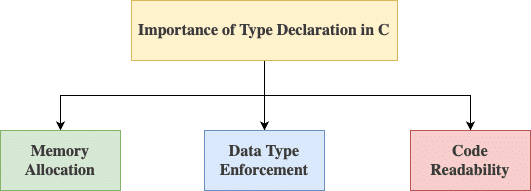
1. Memory Allocation
Every data type has a predefined memory size. Declaring a variable with its type lets the compiler reserve just enough memory—no more, no less—for efficient performance.
2. Type Safety and Error Prevention
C is a statically-typed language. Type declarations enforce that only compatible operations are performed, reducing runtime errors and bugs due to unintended data manipulation.
3. Code Clarity and Maintainability
Declaring variable types explicitly improves code readability. Other developers (or your future self) can quickly understand what data each variable holds and how it’s intended to be used.
Basic Syntax of Type Declaration Instruction in C
data_type variable_name;
- data_type: The kind of value to be stored (e.g.,
int,float,char). - variable_name: A valid identifier following C naming rules.
Examples:
int age; // Declares an integer variablefloat salary; // Declares a float variablechar grade; // Declares a character variable
Each statement allocates space for the variable and tells the compiler how to handle its value.
Common Data Types for Type Declarations in C
Data Type
Description
Size (Typical)
int
Stores integers
2 or 4 bytes
float
Stores floating-point numbers
4 bytes
char
Stores single characters
1 byte
double
Stores double-precision decimals
8 bytes
long
Stores large integers
4 or 8 bytes
Note: Sizes can vary by platform and compiler.
Advanced Usage of Type Declaration Instruction in C
1. Declaration with Initialization
You can initialize variables at the time of declaration for convenience and safety.
int counter = 0;float pi = 3.14;char option = 'Y';
This avoids uninitialized variables that may contain garbage values.
2. Multiple Variable Declarations
You can declare multiple variables of the same type in one line.
int x, y, z; // Declares three integersfloat a = 2.5, b = 3.0; // Declares and initializes two floats
Keep the code clean by grouping logically related variables.
3. Dependent Initialization Order
Always initialize variables in order to avoid undefined references.
int a = 5;int b = a + 2; // Valid: 'a' is already declared
Attempting to use a variable before its declaration will result in a compilation error.
Using typedef with Type Declaration Instruction in C
The typedef keyword allows you to create custom names for existing types, improving readability in complex programs.
typedef unsigned int uint;uint marks = 85;
This technique is commonly used in embedded programming and APIs.
Type Declaration in Arrays and Structures
Array Declaration
int scores[5]; // Declares an array of 5 integerschar name[20]; // Declares a character array for strings
Each element in the array shares the same data type defined in the declaration.
Structure Declaration
struct Student { int roll; float gpa; char name[50];};
Here, each field in the structure uses a specific type declaration.
Common Mistakes in Type Declaration Instruction in C
1. Using Undeclared Variables
total = 100; // ❌ Error: 'total' not declaredint total = 100; // ✅ Correct
Always declare before use.
2. Mismatched Types in Assignments
int age = "25"; // ❌ Error: Incompatible typeint age = 25; // ✅ Correct
Avoid assigning strings to numeric types or vice versa.
3. Changing Variable Type After Declaration
int count;count = 10;float count = 10.5; // ❌ Error: Redeclaration
C does not allow changing the type of a variable after it has been declared.
Frequently Asked Questions: Type Declaration Instruction in C
Q1. What is a type declaration instruction in C?
It is a statement that defines the data type and name of a variable, enabling the compiler to allocate memory and enforce type-specific rules.
Q2. Can I declare multiple variables in one line?
Yes, if they are of the same data type. Example:
Q3. What happens if I use an undeclared variable?
The compiler throws an error. Every variable must be declared before it is used in a C program.
Q4. Can I change a variable’s type after declaration?
No. C is a statically typed language, and variable types are fixed at the time of declaration.
Q5. Why is initialization important in declarations?
Uninitialized variables may contain garbage values, leading to unpredictable behavior. Initializing at declaration improves reliability.
Conclusion: Mastering Type Declaration Instruction in C
The Type Declaration Instruction in C is not just a syntactic requirement—it’s a cornerstone of writing robust, efficient, and readable C programs. From defining basic variables to initializing complex structures, mastering type declarations ensures better control over memory, operations, and logic flow.
Whether you’re new to C or refining your skills, consistently applying best practices in type declaration will elevate the quality and performance of your code.